Wednesday, 20 March 2013

BA6 | Advanced Game Studies #02


Game Analysis #2 - Dear Esther

Dear Esther is an experimental first person adventure game developed by thechineseroom. The game was first released as a free Source Engine mod but was then entirely remade and rereleased as a standalone commercial version in February 2012. 

Dear Esther is a unique game in the sense that it doesn’t follow traditional video game conventions. Very little is asked of the player and the game mainly involves you walking around an uninhabitated island listening to a series of narrated letters by a man who is suggested to be Esther's husband who is dead following a fatal car accident. These voice over sections of the game are triggered when the player embraces specific areas of the island but are chosen semi-randomly which means that no two playthroughs of Dear Esther will be entirely the same.
(All screenshots are ones I have taken in game unless stated otherwise)

 
Structural Framework Analysis

How do the rules and conditions of the game create conflict? 

In Dear Esther, unless the player knows before hand how the game is played/what it is about then they might be in for a shock. The rules of the game are that you just walk, explore, listen and learn. And that’s literally all you can do. 

Another form of conflict evoked within the player by the game is lack of direction, blatant story or character interaction. You play a silent protagonist who you know nothing about until later in the game. For players used to games where story is drip fed in an obvious fashion this might cause conflict, dissatisfaction and separation from what is a clever and unique game.


Are players struggling against each other, the game or both?

In Dear Esther there is no real “struggle” and there is definitely no struggle against another player. The game is purely a single player experience. There are no online functions, no leader boards, no co op and no multiplayer. Just you and the story. If anything there is struggle against the game, a struggle to understand what has happened and why you are there.  A struggle to fully comprehend the narrative and complexity of the story behind the game.


 What are the interactive experiences provided for players in the game?

Interaction in Dear Esther comes in a variety of different forms. Generally, the game has little next to no interaction with the game world. Players can’t find “loot” nor are there any other in game character to interact with. The voice over audio clips of letters aren’t even triggered when the player interacts with a physical in game letter, they are triggered randomly throughout the game when the player reaches certain areas. I guess this is a sort of interaction, the players interact with the environment, they explore, and this makes the narrated letters occur in game. 
 
An article PC Gamer’s website by Lewis Denby talks about how Dear Esther was created when Dr Dan Pinchbeck of Portsmouth University wanted to see what would happen were a game focussed purely on storytelling, to the exclusion of more traditional interactive elements.”. This suggests that the interactivity was removed from Dear Esther and was replaced by narrative story instead suggesting “that you could do more with storytelling in games if you stopped worrying about everything making sense and adding up, and that when you read a book or watch a film, you are filling in a lot of those details yourself”.  It could be argued that the game is an “interactive ghost story”, not a game.

“It’s important that we all keep pushing at the potential emotional range of gaming and how subtle we can make a player’s emotional journey,” he says. “What I hope about Esther is that although it is fairly dark, there are subtle tones to that: an ebb and flow that makes it an interesting journey that we can all recognise, rather than just us standing there hitting the player with the tragedy hammer until they give in.” 
 
Anther form of interaction between players and Dear Esther is through the way the player interacts with the environment.  Dear Esther, although not offering genuine interaction between player and environments, did offer a visually stunning game that players wanted to become fully immersed within as they explored and progressed. When I played I often found intriguing little areas of detail that told their own story. I couldn’t interact with them, touch them or make them do anything. They were just there for me to “fill in the blanks” which I guess is a genuine form of personal interaction.

   
Does interaction create meaningful play?

Certainly. Especially with Dear Esther where the purpose is for the player to fill in the “blanks” of narrative and piece together a story of their own through interaction in its most basic sense. Interaction between the player and the environment, with no subliminal messages from other characters or drip fed narrative, creates very personal and meaningful play. 

  Aesthetic Framework Analysis
  
What does the game look like?

Death Esther is a gorgeous, sandbox exploration based game set on a mysterious uninhabitated island. The game is from a first person perspective and there isn’t any form of user interface on the screen; your view of the island when playing is completely un disturbed which is great considering it’s the only element the player has to interact with other than the fairly complex narrative.

The use of colour in the games environments is very clever. Often the faint orange glow of a candle or green tint of a cave can be enough to entice the player to go and explore the area. 

 
What are the possible visual influences and intertextual references?

On the FAQ’s pages of the official Dear Esther website there is a question asking about the inspired behind Dear Esther. It’s apparent that more writing/writers influenced the game as opposed to visual influences. 

Q. Which authors (novels, movies) inspired the script of Dear Esther?

A. Dan (DE’s writer): “To be honest, most of my inspiration came from games. I did a doctorate in FPS games and this led to the questions that inspired Esther. But I guess in terms of authors I most identify with: Boris & Arkady Strugatsky, William Burroughs, Philip K. Dick, Margaret Atwood, Andrew Greig (if you haven’t read “That Summer” you haven’t lived), J.G. Ballard, Angela Carter, Sebastian Faulks (particularly Human Traces)… I love Soviet-era Russian sci-fi too: Kiri Bulychev and Dmitri Bilenkin are fantastic. Although they haven’t made it into our games yet, I’m a massive fan of good steampunkers too: G. W. Dahlquist and Stephen Hunt are superstars and I want to make a full-on Victoriana steampunk shooter before I die.” 
  
I found this article on ROCK, PAPER, SHOTGUN where an interview between Alec Meer, a write for the website, and Robert Briscoe, the lead artist for Dear Esther. He states in a question put to him by Meer concerning visual influences behind the game that he felt very inspired by Stalker, a 1979 science fiction film directed by Andrei Tarkovsky.
 

>> video reference, credit goes to bioreflex << 
  
Briscoe explains that it was “how his meticulous attention to detail helped create a such a great atmosphere” that influenced him visually when designing the landscapes and environments in Dear Esther.

What other aesthetic qualities does the game present, movement, sound?

Dear Esther provides the player with very basic movements because there is no need for fast sprints, melee attacks, blocks, cover or mechanics to fire weaponry. Sound is presented via the cold, eerie winds that blast past you whilst outside on the island as well as the sound of the sea which can almost always be hear.  Ambient sounds of the island seem to pull focus over actual music. Sometimes there is music that will play in the forms of flashbacks or when you reach specific parts of the game.
 
>> video reference, credit goes to Aenrel <<

Contextual Framework Analysis 

Consider the game in terms of context, origin, year of manufacture, company, target audience, does the game contain any persuasive purpose, what would make the game more effective and what potentials does the game point to?

Dear Esther's origin was a Source engine mod created in 2008. While the ideas were still the same the overall aesthetics of the game were incredibly different. The capabilities of the engine were limited and, compared to the re released version, the overall look of the game was a lot more vacant and empty. Players still rated the game for its experience however.


>> video reference, credit goes to HL2Life << 

  
The re released version of Dear Esther came out 2012 and was a massive improvement over its origin version. Thechineseroom, originally a mod team, branched out to make Dear Esther but before this they worked on Korsakovia, a single player mode for Valves Half-Life2. In Korsakovia, the player travels through the delusions of Christopher who suffers from Korsakoff’s syndrome. Hearing voices of a doctor, the player must try to figure out what is wrong with Christopher. 


 Despite the game starting almost identically to Dear Esther (player chooses start and is immediately in game). You are forced to listen to a woman addressing you directly before you are thrown into the game. Korsakovia is also a first person game like Dear Esther but the games aesthetics are very different. Korsakovia is very dark and grungy with basic textures and models compared to the stand alone version of Dear Esther (which is understandable, considering this is a mod). Similarly to Dear Esther, the game has a voice over which helps the player understand the games narrative. 

Dear Esther’s target audience would have been those who were fans of the original Korsakovia mod and original Dear Esther mod. However with the apparent change in gameplay style from emphasis on play to direct emphasis on narrative, it would seem apparent that the target audience were those who wanted a change in pace and gameplay. Gamers looking for something very different with a narrative driven experience where they would have to use their imagination to fill in holes and fully comprehend what's occurring.

The game persuades the player to consider play in a different style. It challenges them to be open minded regarding the content and the way its delivered. I don’t think, for this type of experience, if could be any more effective.  Dear Esther has the potential to influence the way in which we play games and how narrative driven play can be used for greater effect. It suggests that we don’t need fancy mechanics, over complicated characters and convoluted plot to produce an experience worth playing through.

Monday, 18 March 2013

BA6 | Advanced Game Studies #01

BA6 Contextual Studies

On Wednesday, Sharon gave us a briefing lecture on our new contextual studies project named Advanced Game Studies and Research. According to the brief, for this unit we must consider the potential for “games to be a persuasive medium beyond mere entertainment”.  It will “focus on educational, commercial and political games and their potential for wide-scale influence in society”. 

We will need to analyse and research the various strategies that games use to retain the players focus and how they achieve, or fail to achieve, their goals. We must consider game design and analyse how ethical particular approaches to game design actually are. We must research the ways in which digital games are represented within the media and asses the potential effects of this representation on different audiences. 

During her lecture, Sharon noted out key words we would need to consider, understand and be able to use within our analysis/research work. 

Entertainment
The action of providing or being provided with amusement of enjoyment.

Ethics
The moral principles governing or influencing conduct. 

Social Responsibility
The opportunity of being able to act independently and take decision without authorisation, relating to society and its organisation. 

Realism
The representation in art or literature of things in a way that is true to real life.

Social Realism
A movement in cinema which aimed to make political comment in relation to class and society. 

Games that Depart from the Expected
Educational games
Games designed to impact on health
Games as documentary
Social and political games
Games adapting existing mechanics for new purposes
Games as explorations of history

These terms will prove incredibly helpful when I am researching for, and writing, my final piece of written work for BA6 which must be presented in the form of a series of in-depth research blog posts and a 2000 word essay. However, for now we have been tasked with an Easter project which I actually think will be pretty fun. We must research and analyse 3 different games and give answers appropriate to the areas of study that Sharon gave us in her lecture. We must also look at these game examples from the perspective of “what potentials do they point to?”.  

Sharon gave us the correct meaning of “analyse” which was…

Analyse
To separate something into its constituent parts; examine it methodically and in detail for the purposes of exploration and interpretation. 

With this in mind, Sharon gave us a list of constituent elements found within a game. They come under 3 separate headings; Structural, Aesthetic & Contextual.  These 3 separate headings all contain elements which I must consider when doing my analysis and they will be revealed when I begin the project.
Game Analysis #1 - L.A. Noire

So, game number 1. L.A. Noire. I absolutely adore L.A. Noire, I thought it was a fantastic game so I thought this would be the best game to start with. L.A. Noire is the critically acclaimed game by Team Bondi and Rockstar Leeds. Released in Europe on the 20th May 2011, L.A. Noire saw players take control of officer Cole Phelps; a man who wants nothing more than to climb the corporate ladder and move higher in the law enforcement ranks.

 
The games follows Phelps’ progression through various desks on different departments such as homicide, vice and arson. The narrative leads onto informing the player, and Phelps, that a former U.S. marine soldier from Phelps former unit has been brutally murdered.  Phelps goes on to discover that many of his former squad members are being assassinated. Following a meeting with his old comrade Jack Kelso he learns that the men are dealing surplus morphine after stealing it from the USS Coolidge which was the ship that carried the unit back to LA at the end of World War II. 

Phelps dives headfirst into the investigation, with the aid of Kelso, and learns that the profit made from selling the morphine is funding “The Suburban Redevelopment Fund”. They learn that while at first glance the development fund has good intentions, it is actually a guise for an insurance fraud scam run by Leland Monroe. The rest of the game follows Phelps and Kelso’s struggle to solve the mystery of the suburban development fund and morphine sales whilst Phelps’ life, reputation, career and love life all seem to become spontaneously ruined.


  Structural Framework Analysis

How do the rules and conditions of the game create conflict?

In L.A. Noire the player is forced to play as main protagonist Cole Phelps, a righteous character who only ever tries to do his best within his career.  Although Team Bondi were behind this, the game was also developed by Rockstar Leeds. Rockstar have a history creating games where the protagonist has villain like qualities such as infamous series GTA, where players play as criminals, or Red Dead Redemption where the lead character is a former outlaw. This could cause conflict for some players who might want to play as a rouge police officer, a dirty cop. 

Cole is everything but a dirty cop. The rules and conditions of the game force the player to take on his role as being a good, hardworking police officer who wants to do well in his career. This could possibly cause conflict with the player who might have wanted to play the game differently. 

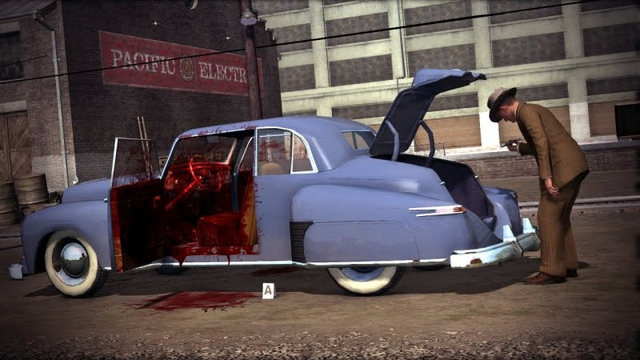
L.A. Noire gameplay is focussed around investigation and interrogation. It is a condition of the game, the player must thoroughly investigate crime scenes for clues. The rules of the game are that if a player hasn’t found specific evidence/clues then particular questions/answers are locked off when interrogating a suspect. This can lead to the player not making the correct arrest or falsely accusing people which can cause conflict both to the player but also to protagonist Phelps as he must make the correct arrests to progress through his career. 

>> image reference, credit goes to FĂĄbio Tavares << 

Similarly, a rule of the game is that only once a player has found specific evidence on a crime scene can the game progress, this can cause conflict if the player just wants to speed through the game and not bother with evidence.  

Are players struggling against each other or the game or both? 

L.A. Noire is a single player experience therefore players can not struggle against each other during play (unless friends who also own the game compare statistics but that’s not really “struggling against each other”).

Players have a struggle against the game, they must attempt to solve crimes and find as much evidence as possible to become a good officer in order to progress through the ranks and beat the game. 

What are the interactive experiences provided for the players in the game? 

L.A. Noire is incredibly interactive. Firstly there is the interactive narrative whereby it can lead the player down different paths depending on their play through. This excerpt from writer Keith Stuart at the Guardian explains is beautifully. 

“What LA Noire represents is a new era for interactive entertainment. Over the past 30 years, games have been based around challenging the player's hand-eye co-ordination – the ability to react quickly with a controller. But in LA Noire, the main skill is emotional perception, being able to judge body language and facial "tells" – the little nervous tics that betray liars. These are the same skills we use in real life and that allow us to engage with characters in TV and movie dramas. Suddenly then, games are a universal medium.” 

One of the first interactive experiences you get playing L.A. Noire are the crime scene investigations. Here the player can freely interact with the crime scene area to find clues associated with the crime. These are interactive for the player because they get to move around and search freely without the game really telling them where to go (unless the player has “clues hints” turned on, in which case the clues are a bit more obvious to find). In this video you can see how the player has free rein to investigate the interactive crime scene (skip to 2:05 for the crime scene).


Another interactive part of L.A. Noire comes in the form of investigating the dead bodies. Whilst on the homicide desk Phelps must investigate a number of murder cases. When investigating crime scenes, the player can also interact with the murder victims for extra clues. This is purely interactive gameplay. 

>> video reference, credit goes to inexcitus << 
 
Another form of interactive gameplay is seen between the player and the suspects when performing an interrogation. Once the player has found as many clues as possible on the crime scene they can continue to interrogate the suspect in the hope that they can make an arrest. This is interactive because there is no set path the player must take. There are a series of variables that can effect the outcome of the interrogations such as how many clues the player found, what evidence they have and which witness’ they spoke to prior to the interrogation. All this information gives the player different options/questions to ask the suspect in order to get a confession and make an arrest.


 >> video reference, credit goes to CruelTroopOfDoomTV <<
  
L.A. Noire used Depth Analysis’s newly developed technology MotionScan. Real actors portraying the games characters were recorded by 32 cameras in order to capture the complex facial expressions from every angle. This was so that players could interact with the game and base their accusations on realistic responses from witness’s and suspects. Once the player asks a character in game a question, the character would appear to produce highly realistic facial expressions of which the player would have to judges whether the character is lying or telling the truth. Players would have to use their real life experience to gauge this decision if they had no evidence to back it up. For example when people cant keep eye contact with you when talking this is often a sign of lying. This is the kind of interactivity players could have with L.A. Noire.


>> video reference, credit goes to IGN << 

Does interaction make meaningful play? 

I believe that L.A. Noire is one of the most interactive games of this console generation that I have played. When players are given the choice to interact with important parts of the environments and characters it makes the narrative and experience far richer than being drip fed story and given constant direction with no choice or moral dilemmas.

 Aesthetic Framework

What does the game look like? 

L.A. Noire is set in a perfectly recreated Los Angeles in 1947 with a clear and heavy influence from film noir. The sandbox style lets players explore the world and appreciate its beauty. Obvious film noir influences here with the harsh shutter/blind lighting as well as the black and white cut scene and chapter title. 


Sharply dressed officers at the scene of a murder.

  
The game can be quite brutal and violent visually especially when on the homicide desk.


The fashion/physical attire of the characters is very appropriate to the time period of the game.  Smoking was, of course, also allowed in doors back then too. 

 
Example screen shot of the beautiful sandbox city.

 
Cars are also appropriate to the time period of the game.  

What are the possible visual influences? 

I found this really interesting article (http://uk.gamespot.com/features/the-influences-of-la-noire-6313180/) on Gamespot which discusses the influences of L.A. Noire, from the movies which inspired it to the music, television shows, authors and locations. 

Movie Influences 

According to the Gamespot article, movies which influenced L.A. Noire were as follows… 

"The Sweet Smell of Success"


>> video reference, credit goes to oldhollywoodtrailers << 

Apparently it was the “stunning views of a city at night” within this film that inspired L.A. Noire. As you can see here I have used one of the previous screen shots to emphasise how the Sweet Smell of Success influenced L.A. Noire’s chapter titles.
 

"The Asphalt Jungle"


>> video reference, credit goes to agelesstrailers << 

This film shows clear influence upon how L.A. Noire designed it’s characters. Their styles and costumes in both the males and females are similar. The way the narrator speaks over the trailer is similar to that of the game where characters and narrative are told to the player. This also ties in with how some characters are introduced to the player, they are described with a short tag line description.

Interestingly there is also a trophy/achievement in L.A. Noire which is a throw back to the film The Asphalt Jungle which has the same title.


 >> video reference, credit goes to PowerPyx <<

TV Show Influences - "Naked City"

The Gamespot article also states that L.A. Noire was influenced by TV shows too, one of which was Naked City, a police drama series released in 1958.


>> video reference, credit goes to fwohhp << 

  There was even a DLC chapter named The Naked City released for L.A. Noire further proving the visual influence.
 
>> video reference, credit goes to machinima << 
  
Location Influences
The articles suggests that L.A. Noire had some genuine location influences. 

The Egyptian Theatre LA

 The Egyptian Theatre was built by a man named Sid Grauman in 1922 and serves as one of the locations that influenced L.A. Noire, so much so that players can actually visit it in the game.  On the left is the actual Egyptian Theatre, the shot on the right shows how it looks in game.

>> left image reference <<                                                          >> right image reference <<

 
L.A. Noire has a vast array of visual influences, most coming from pre existing media such as films and TV series. The most notable form of visual influence L.A. Noire displays are taken from the early 1940’s to late 1950’s film noir’s. Film noir is a cinematic term used to describe classy, chic Hollywood crime dramas.

Film Noir tends to be presented with low key black and white visuals, this technique is also used in L.A. Noire when new cases in game are displayed to the player with a cinematic trailer. This trailer is always in black and white and shows the title in a similar fashion to many of the film noir crime drama films (refer back to The Smell of Sweet Success).  The use of black and white visual influences are so strong in L.A. Noire that the player is even given the option to play the entire game in black and white. Playing the game this way looks like it has been ripped straight from the film noir Hollywood drama era and it works so well.


>> video reference, credit goes to FullCodedAlchemist << 
 
What other aesthetic qualities does the game present - movement, sound? 

To move around the beautiful open world of L.A. Noire players are given the option to drive 95 different vehicles designed appropriately to 1947 Los Angeles.
 
>> video reference, credit goes to PowerPyx << 
  
Referring back to the Gamespot article where musical influences are mentioned, it’s obvious that L.A. Noire is trying to recreate the classy, smooth music of the 1940’s to truly enhance the ambiance and tone of the game. One of the major music influences comes from jazz, or more specifically, Miles Davis: Kind of Blue.


>> video reference, credit goes to LĂȘnin Bastos << 
 
Contextual Framework 

Consider the game in terms of context…origin, year of manufacture, company “house style”, target audience, any persuasive purpose?, how could the game be more effective?, what potentials does that game point too? 

L.A. Noire’s origin lies in the beautifully recreated 1947 Los Angeles with subtle hints of detail linking it back to its film nor roots; it’s hard to miss the Hollywood crime drama influences.

Released in 2011, this is one of Rockstar’s newer titles but in many ways it’s not a typical Rockstar game. You don’t play as a crazed sociopath criminal out for revenge. No, you play the good guy trying to eliminate evil. This is different to previous Rockstar flagship titles such as the Grand Theft Auto series, Bully and Manhunt where violence seems to be the answer, L.A. Noire offers a different approach. In terms of narrative, gameplay and game visuals L.A. Noire does show flares of “house style”. For example, the game is presented to the player from a third person perspective, similar to that of the newer Grand Theft Autos and Red Dead Redemption. Another common element these games share are the style of mini map. A small circle displayed in the bottom left corner of the user interface is very common in Rockstar games. (Top left is from GTA4, top right is from RDR and the bottom is from L.A. Noire) 


L.A. Noire shipped with a mature/18 certificate meaning it was supposed to be played by adults only. The game contains violence, crime and adult themes so it was only right to give it this age rating. Realistically, L.A. Noire’s target audience could have been incredibly varied, from those who are fans of previous Rockstar titles, have interest in film noir, 1940’s-50’s culture and lived in that era, interest in Hollywood crime dramas to those genuinely just interested in taking on a role within law enforcement. 

L.A. Noire persuades a percentage of gamers to consider a completely different time period and culture to embrace it, learn about it and respect it. The game was so historically accurate and cleverly built that there isn’t really anyway this game could have been more effective in conveying the culture behind it. 

Potentially this game could teach those who aren’t knowledgeable of popular culture in the 1940’s era of LA. Accurate landmarks, vehicles, streets, maps, clothing, weaponry, language and other miscellaneous areas of the game help built the coherent world of a 1947 Los Angeles.