Monday, 8 April 2013

BA6 | Advanced Game Studies #03


Game Analysis #3 - Spore

In 2008 Maxis released Spore, a god game where players take control of the development of a species of which they create themselves. They begin their life as a microscopic organism and the player must control their development as the creature becomes more intelligent and grows as a species.

Unfortunately I couldn’t get a hold of a copy of Spore, nor could I find an affordable copy to buy :/ Therefore this analysis may be slightly less informed than my previous 2.


Structural Framework Analysis  

How do the rules and conditions of the game create conflict?

One possible rule/condition seen at the beginning of Spore comes in the form of a choice. Players are forced choose whether their creature is a herbivore or a carnivore. No big deal, right? Wrong, from the videos I have been watching and reviews I've been reading it seems that carnivores are portrayed as a more brutal species compared to herbivore as they tend to have to fight and enter combat throughout the game to survive. Herbivores seem to befriend other herbivores and have a much calmer development cycle. This rule/condition of gameplay can cause conflict between the different species within the world of spore later in the game. This is most apparent at the “creature” stage of the game where carnivores must go around killing and destroying in order to progress whereas herbivores seem to have it much…friendlier? 

Are players struggling against each other, the game or both?

As there are 5 separate elements of gameplay styles in Spore, it is difficult to label the game in terms of multiplayer options. These stages are cell, creature, tribal, civilization and space stage. The cell, creature, tribal and civ stages are all single player components of the game.  However, the space stage of spore allows players to roam around the Spore galaxy, finding new planets to land on and explore. Most of these planets are run by other human players or have been created by them. However, players can not “go to battle” or enter combat with other players like one would in a multiplayer game. No, instead these worlds are populated using the pollinated content, all creations, creatures, buildings and vehicles etc, are automatically shared and can be found in the “Sporepedia” (a sort of online Spore content library).

So, having said this, I can conclude that players aren’t ever really struggling against each other. Unless perhaps they want to better what someone else has created and dropped in the Sporepedia but that’s not really what the game’s about. Ultimately the player is struggling against the game. 
 
What are the interactive experiences provided for players in the game?

In some ways, Spore is one massive interactive experience. The chance for a player to fully interact with the development of something they themselves created. However, this conclusion depends on how we depict “interactive”. I guess the “god” element of the game suggests that its an interactive experience but not one that continues after the games been switched off..

Perhaps the Sporepedia can be considered an interactive experience for the player as they can interact with all the community made content that has been created and also submit creations of their own.
 
 
>> video reference, credit goes to pivotnils << 

Referring to my initial point, players can literally create what they want too, surely this is interactivity? The player must interact with the game and their creature or world to enhance it. They get to choose how their creature looks and how it behaves in the world of Spore. 

 
>> video reference, credit goes to Spore << 
 
 Does interaction create meaningful play?

From what I can gather, without actually playing the game, this interaction with your spore creature most definitely creates meaningful play. You don’t want a creature you designed from organism to creature fail miserably. No, you want your creature to do great and be amazing. The personal stake in your creature from the interactive elements of the game creates meaningful play definitely. 

Aesthetic Framework Analysis

What does the game look like?

Visually, Spore is very bright, colourful and vibrant. Personally, from what I have seen of the game, I find the creature models quite comical in appearance. As I mentioned previously, the game is split up into 5 separate sections of gameplay and each portrays a different “look” in terms of aesthetics and presentation. 

Stage 1 - Cell Stage. This is a birds eye view section of the game with very simplistic controls and objectives. Visually it’s very simple but colourful and vibrant. 
 
 >> picture reference <<
 Stage 2 - Creature Stage. This section of the game takes on the “3rd person action adventure” role. Players assume the direct control of their creature and move it around the world. 
 
 >> picture reference <<
 
Stage 3 - Tribal Stage.  Not that visually different from the creature stage except players are given structures to play and interact with whilst progressing through the development of their creature.   
 
 >> picture reference << 
 
 Stage 4 - Civilization stage. This is supposed to reflect popular god games such as it’s namesake, Sid Meiers Civilization series. 
 
 >> picture reference <<
 
 Stage 5 - Space Stage. Players get to control their ship and move their creature through various galaxies ready to explore. 
 
>> picture reference << 
 
What are the possible visual influences and intertextual references?

Whilst searching for gameplay videos of Spore I came across the Zero Punctuation review, which is admittedly frank and to the point with dark comedy. However, there is an adequate point made about the different level stages of Spore and how they are just like pre existing games. So this could be considered an influence. Skip to 2:58 to see the visual influences for each stage of the game or watch from the start to see a comical video review of Spore.
 
 
>> video reference, credit goes to TheEscapistMagazine << 
 
Contextual Framework Analysis

Consider the game in terms of context, origin, year of manufacture, company, target audience, does the game contain any persuasive purpose, what would make the game more effective and what potentials does the game point to?

Developed by Maxis and designed by Will Wright, Spore was released in 2008 for PC and Macintosh. Described as a massively single player game players assume the god role and create an army of creatures, developing them from organic cell through to galaxy exploration. 

Spores target audience can vary greatly, often described as trying to please a wide variety of different gamers and supporting varying styles of gameplay to suit. With elements of 3rd person action, simplistic FLOW-esque top down games and RTS games Spore offered options to many different gamers suggesting that its target audience was…well, pretty much everyone. 
 
From what I can tell most of the sections of different gameplay needed more work or just needed to not be there, this is what I can understand from reviews. Having said that, Spore points to a potential of learning. Learning about development cycles, growing a community of your own, making adult decisions and ensuring your creatures are okay. These are all responsibilities which the player must take seriously in order to successfully manage the game.

Sunday, 31 March 2013

BA6 | Specialism #05

Progress Update

I’m struggling to keep to my, admittedly, unrealistic timetable over the past week due to life getting in the way and working the Easter bank holidays. Regardless, I am trying to maintain a decent level of motivation, which I’m finding hard, but I feel that I finally have a clear(ish) idea in my mind for the assets I plan to create for my small environment area. I want to do a bit more in game visual research before I dive in and I’m certainly a few research posts/concept designs away from modeling just yet but now that I am on the right track I can keep moving forward rather than feeling like I’m hitting my head repeatedly against a brick wall.

Uncharted 3

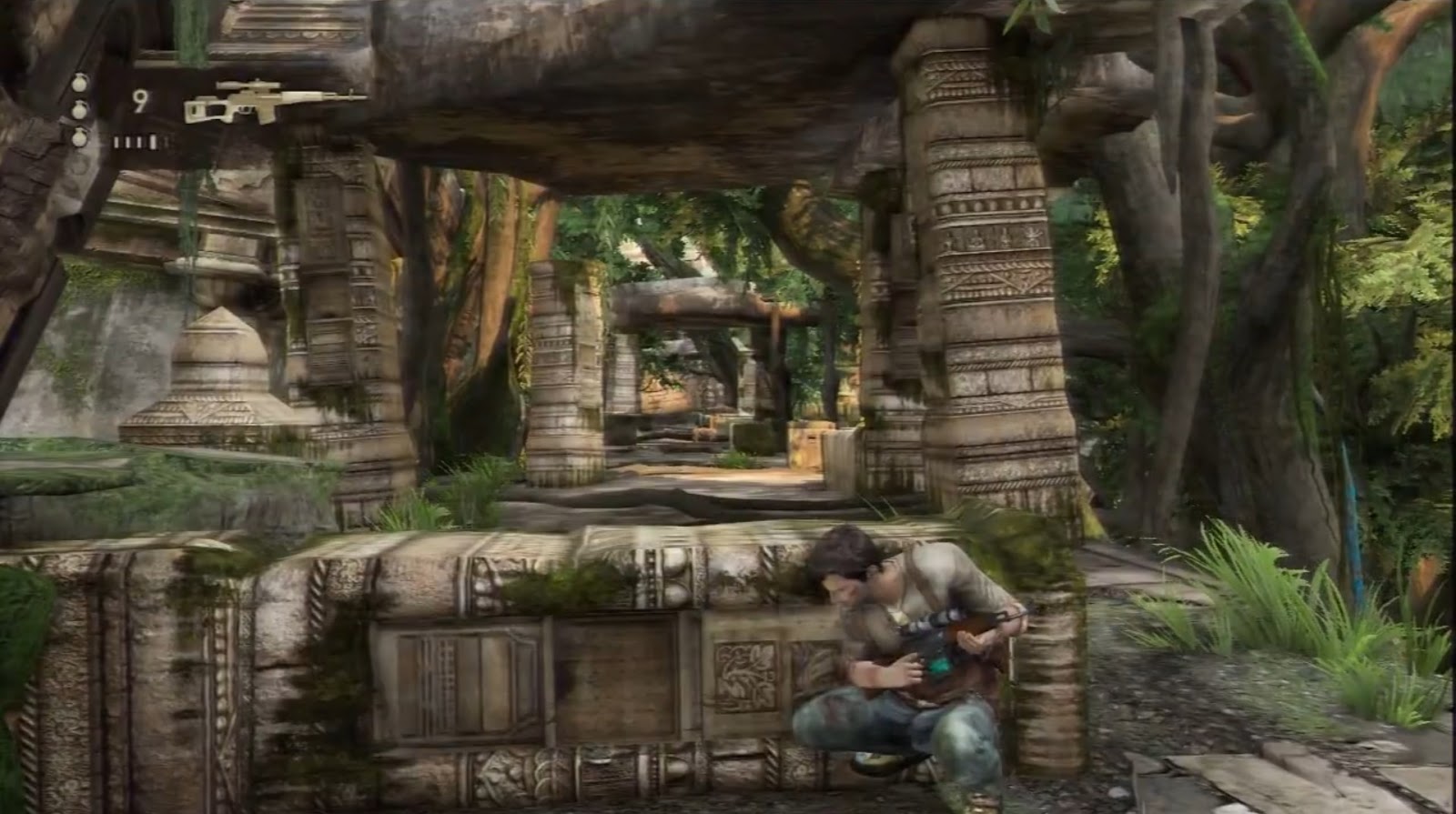
I am starting with another selection of screen caps I have taken from a video walkthrough of Naughty Dog’s latest masterpieces, Uncharted 3. Whilst this game is primarily focused within the desert, there are a couple of chapters at the beginning of the game where Nate and Sully find themselves in a jungle deep in France. I thought this would be good to study for influences and inspirations for my semi jungle/temple/mysterious environment that I’m trying to narrow down! 

Here is the video that I used to take the screen shots below...

I really like the different levels of terrain, how the rocks are mounted upwards and vegetation covers them. I also need to remember to consider these images when doing texture studies. 

I think the way the tree forms an archway for the player is effective environment creation. It creates a frame for the games pathway bridging the environment and the game together for the player. 

Similarly here, the trees and rock formations create a pathway so that the player can read the environment in terms of gameplay and understand where they must progress to.

 More inspiration for possible monuments I could build and how they would react to weathering within a jungle environment, how they would deteriorate and break down and how they would appear visually. This is also inspiration for composition and structure. 

I love the way the tree roots are hanging down over the rock cave just ahead of drake.

More visual influences for how structures are broken, weathered and aged within a jungle environment, very similar to that within my imagination of how structures (if any) would appear in my environment.   
 
Inspirations!!

As I am struggling a bit to decide on the core assets that I want to create within my jungle-esque environment I thought I would do some basic research into what people have already created in 3D in the hope it would inspire me. Here are some inspirational pieces of work that I have found which I know are going to help influence and inspire me.

Firstly, I started by searching tags such as “3D jungle assets” to see what came up. After a while I came across a websitehttp://www.minifloppy.it/, which belongs to Francesco Camarlinghi (or “minifloppy as he’s known on the internet). On here, minifloppy shows his UDK jungle model that he has created in the form of a video (which I think is really impressive). 

 
 >> video reference, UDK jungle by minifloppy <<
 
I found this video incredibly helpful and inspirational because it contains just the type of elements I would like to model in my work. Obviously I can’t build something on this scale, it’s the assets I am focusing on but yeah, totally inspirational. There are also a couple of screen caps where minifloppy has shown un-textured renders of some of the smaller assets within this environment which I am finding incredibly helpful to look at. 
 
I then came across Daniel McGowan's blogger where he showcases some 3D art from the game Hunted: The Demons Forge (which I haven't played, but I have heard of) which is reminiscent of the ideas I have for my 3D environment. 
 
 
I mentioned earlier that I really liked the way that the tree roots draped down over a large rock formation in Uncharted 3. Well, I also found another blogger from 3D artist/modeler Christine Snelling who shows a model where some tree roots do just that. It’s really helpful to see this created as an actual 3D model.


Another render she shows is helpful to me as she has textured the rocky roof and showed how the moss and vegetation would have overtaken and grown upon the tiles.


I also found artist Tom Schillinger's BlogSpot which contained a small variety of Vietnam jungle inspired assets which I am finding really inspiring to study.  I really like the idea of creating a bridge, and keeping in them with the idea of it being a mysterious/magical area maybe it could be floating similar to Martin Teichmann’s floating world project I studied earlier. I also want to have a crack at building a tree/tree trunk. I think its really helpful to have examples of both 3D created models photograph references so these will help me greatly.  

 
From a basic Google image search for 3D jungle assets I was able to find a website which offered these stock models that people could buy/download to use within their environments. I have absolutely no intention of doing this for my project; whats the point? But I do find them very helpful in terms of inspiration and influences.

 
To finish up this long, image heavy influence/inspirations blog post I am going to show the image I found posted up on http://www.game-artist.net/forums/vbarticles.php?do=article&articleid=47 where Rob Adams, a previous lead level designer at Naughty Dog, was being interviewed and was discussing Uncharted Drakes Fortune. When asked about the challenges faced for level design he talks about player cues, direction and hints that the environment can give. He states that lighting, composition, mood colours, lead-in lines and audio cues that work alongside the environment are incredibly important.   

Next, there is an image shown of a heavily vegetated jungle environment which I found really helpful and inspiring because it shows the model with the wire frame over the top showing how some of the structures and formations were modelled. I think this is incredibly helpful!

Friday, 29 March 2013

BA6 | Specialism #04


How Can Uncharted 2 Help Me?

Possible Spoilers 

Well other than the game being amazing, Uncharted 2 can help me a lot visually. When I decided to take on a jungle-esque,  mysterious environment I thought of this game straight away. During the later chapters of the game Drake, Elena and Chloe find themselves in the ancient, lost city of Shambala. Shambala is a mythical hidden kingdom supposedly located somewhere in Inner Asia. Throughout these final few chapters, the team must battle their way through the ancient city ruins of Shambala, fighting their way through waves of creatures who inhabit the lost city as well as a number of main villain, Zoran Lazarevic’s, henchmen.  

The environments in these chapters are stunning and just the kind of inspiration I needed. I am currently struggling to determine the actual assets that I want to create which is why I have extended my research period for the project to ensure I can properly determine my asset list for my project. I can’t begin modeling until I know so I need to step my game up and push on >:) 

Here are some screen caps I took whilst watching an Uncharted 2 walkthrough on YouTube by Joanastic. As Uncharted 2 is only on PS3 I was unfortunately unable to take my own screen caps. I will write up a list at the end of key assets and environmental elements that I find inspiring and that I could use to influence my environment. 

 
What Influences me from the Shambala Chapters of Uncharted 2?
 
  How the vegetation isn’t only shown through 3D models, it also takes over textures too.
Consider how texture patterns can be used to replicate that mysterious atmosphere and correctly portray an environment.
Rocks of different sizes, be creative!
Broken rubble from where ancient ruins have aged and deteriorated left lying on the floor.
Large tree roots growing up what would have once been beautiful flooring.
Delicate architecture in contrast to where it has broken and aged.
Large scale of structures such as statues and architecture.
Consider how natural plant life would react to the ruins, for example how vines are wrapped around structures.